

This summer, I’ve writing a blog series focusing on several different disorders that affect children at school: ADHD, Autism, Bipolar Disorder, Depression, Anxiety Disorder, and ODD. Each entry will describe the disorder, give practical strategies for improving success at school, and also a few social-emotional goals and accommodations that might be appropriate for students with special education services!
Next up is Bipolar Disorder. Although mostly diagnosed in teens or adults, many more children are now receiving diagnoses of Bipolar Disorder, so it is becoming more and more common in school settings. In bipolar disorder, people experience abnormally elevated (manic or hypomanic) mood states which interfere with the functions of ordinary life. Many people with bipolar disorder also experience periods of depressed mood, but not always. Diagnosing bipolar disorder is often difficult, even for mental health professionals. In particular, it can be difficult to distinguish depression caused by bipolar disorder from pure unipolar depression or other disorders. I’ve even had kids that actually really had Autism be given an ADHD/Bipolar Disorder combo before being correctly identified!
Symptoms:
 Mania Episodes –
- Elevated or irritable mood or euphoria
- Increased energy or decreased need for sleep
- Distractibility
- Fast speech
- Thoughts appear to be “racing”
- Impaired judgement sometimes leading to risky or impulsive behavior
- Breaks with reality (sometimes)
Hypomania Episodes –
- Mild to moderate states of mania
- Increased energy and activity levels
- Often feels good to the person experiencing it
- Less interference with functioning, compared to manic episodes
- Symptoms generally last a few weeks to a few months (but can be shorter or longer)

Depressive Episodes –
- Persistant feelings of sadness, anxiety, guilt, isolation, or hopelessness
- Changes in sleeping patterns
- Changes in appetite
- Loss of interest in previously-enjoyed activities
- Difficulty concentrating
- Suicidal thoughts or actions
- Symptoms usually last several weeks to months if left untreated
- Contact the child’s doctor if medication is to be given at school to make sure you have up-to-date dosage and administration instructions. However, don’t tell a parent “your child needs to be on medication.” You can encourage them to talk about concerns they may have with their child’s doctor, but put your school in a vulnerable position if you start doling out medical advice!
- Encourage the student to get involved in extra curricular or sports activities in order to boost their confidence and self-esteem
- Keep routines and schedules structured and predictable so the student will know what to expect
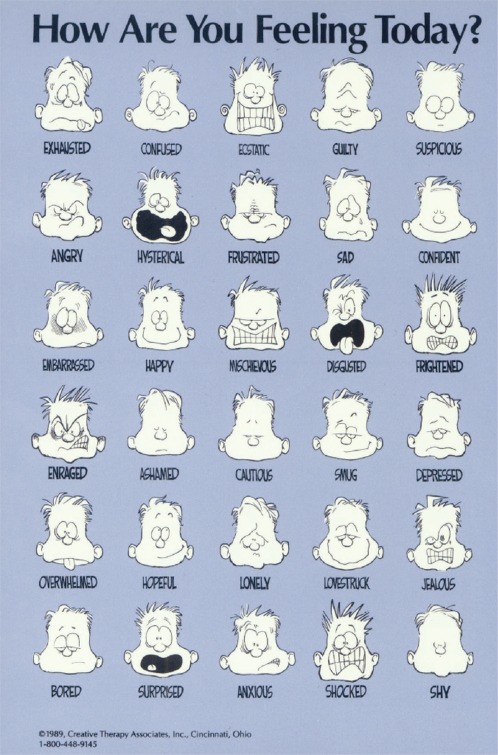 Teach students what different emotions “feel like” to their body to help them identify when they may be entering periods of (hypo)mania or depression
- Improve students’ vocabulary of various emotion words to express their feelings to others
- Provide visual reminders of behavioral expectations such as pictures of rules posted on their desk, behavioral charts, etc., or have students act out rules.
- Teach relaxation strategies or other calming techniques for students to use during times of (hypo)mania or when upset or angry.
- Provide a “cool down” or break area with stress balls or other activities, as well as visual reminders of learned relaxation and calming skills.
- If parents approve, teach older students facts about what Bipolar Disorder is as well as statistics about the disorder to help normalize their experiences and help them feel less “weird” or “different.”
- Provide group or individual counseling-type services to help students combat several types of irrational thinking seen during times of depression. If you need materials, check out this Positive Thinking Pack.
Sample Goals
- Given small group practice, Mallory will improve her classroom performance from requiring frequent redirection to independently remaining in her seat and following directions with no adult prompting.
-
Given behavior training, James will improve his behavior in the hallway from running and bumping into others to keeping his hands to himself, maintaining appropriate personal space, and following verbal directions with minimal adult prompting.
-
Given relaxation training, Max will improve his emotional regulation skills from yelling and becoming physically aggressive when upset to taking deep breaths, relaxing tense muscles, and moving to a quiet place when upset with no more than 1 adult prompt.
- Given instruction regarding Bipolar Disorder, Sarah will increase her knowledge of Bipolar Disorder from not knowing any
 information about it to listing facts regarding prevalence, symptoms, and treatment independently.
Sample Accommodations:
- Provide a private, quiet place for calming down when irritated or over-excited
- Allow students to use cue cards or other visual tools to express their feelings if they struggle with verbal expression
- Give breaks or extended time if you can tell the student is struggling to focus
If you’re looking for activities for your students, check out my Dealing with Anger Activity Pack, Anger and Coping Skills Bingo, and Social Skills Cards: Feelings Pack Freebie! You can also check out my Pinterest Boards for Feelings, Anger Management, and Mental Health for even more ideas!
Thanks to Wikipedia for contributing to this article!

 1. Extrinsic motivation is not the enemy. The argument a lot of people use against many different types of reward systems is that it encourages students to work for “things” rather than that “feel good feeling.” And while this can be true, I want to offer a thought. Adults are extrinsically motivated too. If you were to ask 100 adults why they work, I guarantee that one of the top reasons would be because they earn a paycheck. Sure, many adults works also primarily because they feel a sense of pride, feel like they’re making a difference, or changing the world, but if there was no paycheck attached I’m assuming that a great majority of the world would be unemployed. And when was the last time you used your own paycheck to buy “feel good feelings?” I used to hate it when my mom asked me to do something “because I would feel good about it.” So while intrinsic motivation is awesome, extrinsic motivation can be very beneficial to. It just shouldn’t be the only motivation.
 Use A Variety of Reinforcers
 nowledge (a worksheet vs. “create your own” test vs. “tell your partner”). Choice helps students cater their own learning toward their interests while discovering and developing their own strengths. If doing this is too overwhelming for every assignment, just pick 1 day each week. After a year, you’ll have 36 days of differentiated instruction. After 3 years, you’ll have 108! Or…find a friend to each pick a day each week and you can get a differentiated year 2 or 3 times as fast!
 We educational people live and breathe this fact almost every moment of every day. We differentiate, flex group, and we try to give every student exactly what they need. This is why we all look like post-apocalyptic zombies come the beginning of June! But what I mean by this is that the students have to know it too! I often use the Band-Aid analogy in that if a student came in with a broken arm, I wouldn’t give them a Band-Aid just because their classmate got a Band-Aid for a paper cut that morning. There are tons of visual lessons and demonstrations that can be used to teach this fact to kids and I highly recommend weaving it into every aspect of what you do in the classroom. Reminding kids that “I give every student what they need even though it’s not the same thing” is so important because as you and I know, when they get to the real world things are not the same for everyone. People earn giant promotions or get laid off, live in trailer parks or giant mansions, have 5 kids or suffer through infertility. Students will have so much more respect and trust for you if they know that they’re going to get what they need from you even if it’s not every other kid in the class needs.

 The end of the day approaches. A few of your colleagues get to leave 30 minutes early because their names got moved “up” to blue. This leaves you with extra work that has to be done before you can leave. Among these colleagues, one of them had his name moved up to purple, so he is buying a round of drinks for everyone… Everyone who can leave early, that is. It’s always the same people who can leave early, and really, they’ve become quite clique-y. You convince yourself you wouldn’t really WANT to have drinks with them,